SpaceX's $50 Billion Arizona Supercomputer Raises Questions About Military AI and Environmental Risks
If completed as proposed, it would rank among the largest data center developments in the United States by electrical capacity.

SpaceX plans to build a $50 billion supercomputing campus in rural Arizona that could become one of the nation's largest data centers, raising questions about its potential military applications and environmental impact.
The proposed $50 billion supercomputing campus near Cochise would have an estimated electrical demand of 6 gigawatts at full build-out, according to county planning documents. If completed as proposed, it would rank among the largest data center developments in the United States by electrical capacity.
The company's artificial intelligence subsidiary, xAI, already provides technology used in the Pentagon's Project Maven, a military AI program supporting intelligence analysis and targeting operations. A June federal court declaration confirmed that xAI's Colossus 2 supercomputer in Mississippi helps train and improve AI models used by the military.
SpaceX has identified national security among the proposed Arizona campus's intended applications but has not publicly disclosed whether the facility would support Project Maven or other specific military programs.
During a Nov. 4 town hall, residents questioned whether the proposed campus could become a target for foreign adversaries.
"You are making us an even higher threat than we are, a higher risk than we already are for threats from terrorism, foreign actors, etc.," one resident told a SpaceX representative.
The representative acknowledged that SpaceX operates highly secure facilities facing threats from foreign powers but said the company's supercomputing facilities were not considered as threatened as its rocket launch sites.
Military AI and Project Maven
SpaceX operates Starshield, a satellite platform developed for government and national security applications, including secure communications, Earth observation and hosted military payloads.
The company also has ties to military artificial intelligence through its subsidiary xAI, which has secured Pentagon contracts for national security applications.
One military AI initiative, Project Maven, was launched by the Department of Defense in 2017 to analyze surveillance footage and imagery using artificial intelligence. The program has since expanded to help identify potential targets, process intelligence and support military operational decisions.
During the Nov. 4 town hall, a resident questioned whether the proposed Cochise County supercomputing campus could support Project Maven or similar military intelligence operations.
"I'm not familiar with Project Maven," a SpaceX government and community affairs representative responded, suggesting another company official might be able to address the question.
However, nearly five months earlier, a senior Pentagon official had already confirmed xAI's participation in the program.
In a June 15 federal court declaration, Cameron Stanley, the Pentagon's chief digital and artificial intelligence officer, confirmed that xAI's Grok government model was deployed within the Maven Smart System for national security missions, including targeting and intelligence operations.
The declaration also identified Colossus 2 in Mississippi, one of xAI's largest operating supercomputers, as infrastructure used to train and improve AI models employed by the military.
Stanley further described how Grok's integration into Maven supported military operations, including targeting during Operation Epic Fury.
The declaration establishes that xAI's technology is used in military operations, although it does not identify the proposed Cochise County facility as part of Project Maven.
It remains unclear whether SpaceX's planned Arizona supercomputer would train, improve or operate AI models used by the Pentagon.
SpaceX's Environmental Record
SpaceX's existing supercomputing operations have also faced scrutiny over their environmental impacts.
In April, the NAACP filed a federal lawsuit against xAI and its subsidiary MZX Tech, alleging violations of the Clean Air Act stemming from the operation of 27 natural-gas turbines in Southaven, Mississippi, used to supply electricity to the Colossus 2 supercomputer in the Memphis area.
The lawsuit alleges that the turbines operated without required air permits, potentially exposing surrounding communities to pollutants including nitrogen oxides, fine particulate matter and formaldehyde, a known carcinogen.
Environmental groups have also challenged plans for additional turbine capacity in Mississippi, raising concerns about the potential effects of emissions on nearby communities.
A federal judge denied xAI's motion to dismiss the lawsuit in October, allowing the case to proceed. The decision did not establish that the company violated environmental laws.
The Mississippi controversy offers a potential comparison as SpaceX seeks approval for an even larger supercomputing development in Arizona.
However, the proposed Cochise County campus uses a different primary power arrangement, with electricity expected to come through regional electric cooperatives rather than on-site gas turbines.
SpaceX's Natural-Gas Assurances Face Questions
During the Nov. 4 town hall, Riley Trettle, SpaceX's head of energy and supercomputer development, assured residents that the proposed Cochise County campus would not use natural-gas turbines to generate electricity.
"There will be no gas turbines on site. There will be no on site power generation," Trettle said.
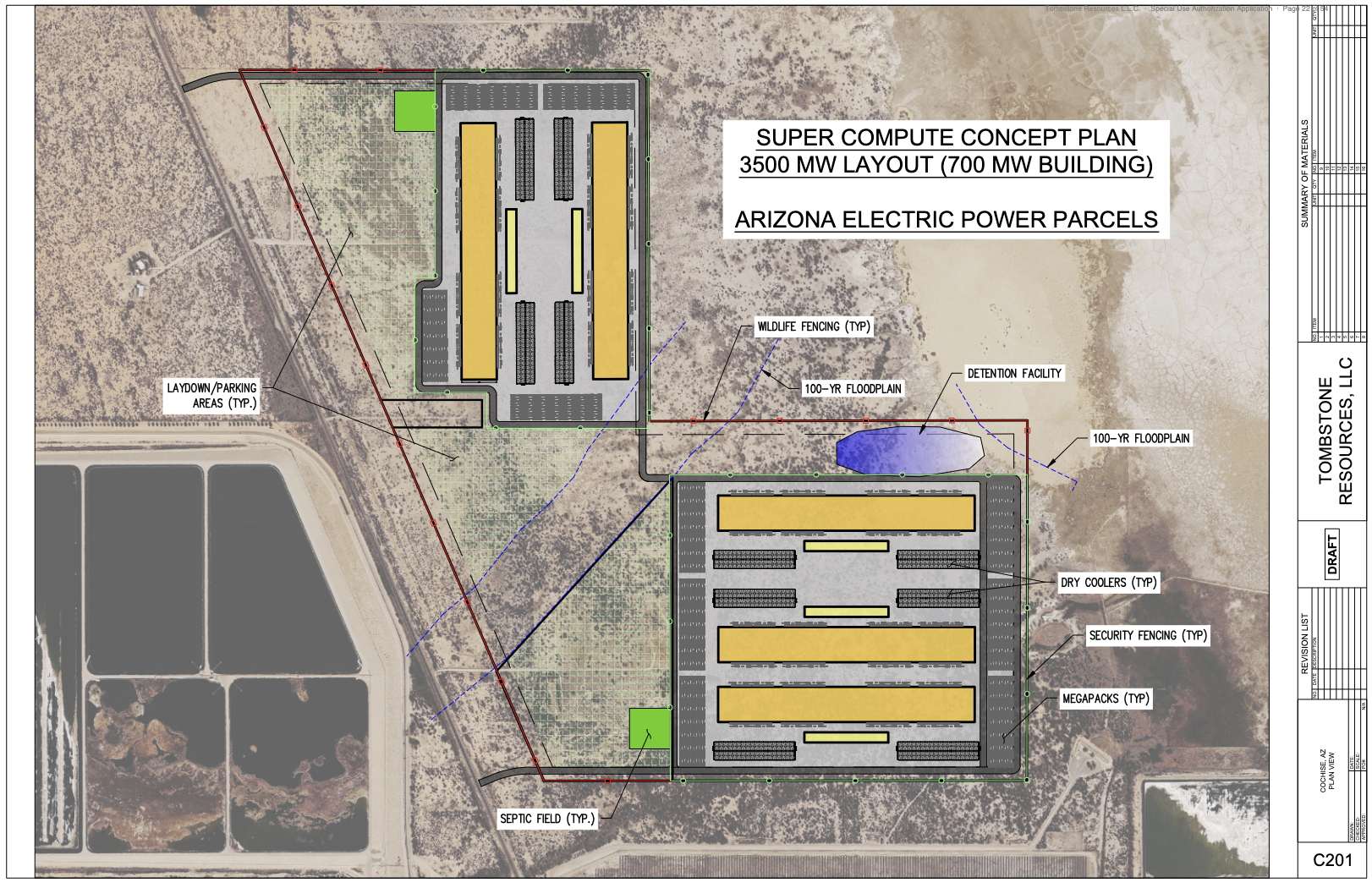
However, SpaceX's permit application describes approximately 10 megawatts of natural-gas-fired standby generation for each of the campus's nine proposed computing buildings, potentially totaling 90 megawatts at full build-out.
Although standby generators differ from the gas turbines used to supply electricity to Colossus 2, their inclusion raises questions about Trettle's broader assurance that the Arizona facility would have no on-site power generation.
The proposed standby generators could also introduce additional air-quality and noise considerations, depending on their design, permitting requirements and operating schedules.
The permit application identifies the generators as emergency power equipment rather than the primary electricity source for the campus.
Questions Over Water Consumption
SpaceX has also emphasized that its proposed campus would use a closed-loop cooling system designed to eliminate routine industrial water consumption.
During the Nov. 4 town hall, Trettle told Cochise County residents that the project would have "zero industrial water usage forever."
However, the company's permit application estimates that the facility would require 3 million to 6 million gallons of water to initially fill its cooling systems during construction, followed by 7 to 10 acre-feet annually — approximately 2.3 million to 3.3 million gallons — for ongoing operations.
The application also identifies potential additional water requirements for construction and reserve cooling.
SpaceX maintains that its dry-cooling design would eliminate the need for routine evaporative cooling. The initial water needed to fill a closed-loop system is distinct from water consumed continuously during operation.
The company's direct water estimates also do not account for water potentially required to generate the electricity powering the facility.
That distinction has become a concern for Arizona Attorney General Kris Mayes, who has questioned whether the project's broader water demands have been adequately evaluated.
Arizona Attorney General Calls for Delay
SpaceX's proposed development comes amid a political shift in Arizona, where Democrats won control of both chambers of the state Legislature in the November midterm elections, positioning the party to take unified control of state government for the first time since 1966 when the new Legislature convenes in January.
Arizona's Democratic attorney general, Kris Mayes, has urged Cochise County officials to delay a Dec. 9 vote on the proposed supercomputing campus, citing concerns about electricity demand, groundwater depletion, public safety and potential interference with nearby military operations.
"The scale of this project is unprecedented for Cochise County and the entire state," Mayes wrote in a Nov. 19 letter to the Cochise County Planning and Zoning Commission.
According to the attorney general, the facility would demand 6 gigawatts of electricity at full build-out, equivalent to nearly 20% of Arizona's total electricity-generating capacity.
Mayes said the proposal would rank as the third-largest planned data center in the United States.
PRIMARY DOCUMENT
November 19, 2026 — Arizona Attorney General Kris Mayes' letter to the Cochise County Planning and Zoning Commission concerning SpaceX's proposed data center.
The attorney general warned that the facility's enormous electrical requirements could strain Arizona's power grid and questioned how SpaceX would obtain the additional generating capacity needed for full operation.
"SpaceX has provided no details about how it plans to close that capacity gap," Mayes wrote.
The proposed facility would initially require 1.5 gigawatts of electricity before eventually expanding to 6 gigawatts, substantially exceeding the generating capacity of the nearby Apache Generating Station.
Mayes suggested that meeting the project's electricity requirements could involve new transmission infrastructure or additional natural-gas generation, potentially creating environmental impacts beyond the campus itself.
She also questioned whether SpaceX's water estimates sufficiently account for the electricity required to operate the facility.
In her letter, Mayes acknowledged the company's plans to use a dry-cooling system but warned that the project's massive energy demand could place additional pressure on the region's already-depleted groundwater supplies.
"Just one natural gas plant, generating one GW of power and running continuously withdraws between 3.6 million and 6.8 million gallons of water per day," Mayes wrote.
The figures describe water withdrawals associated with a hypothetical 1-gigawatt natural-gas power plant, rather than confirmed water consumption by SpaceX's proposed facility.
"The County should have the benefit of understanding the full scope of the facility's water needs, including the water needed to meet its voracious appetite for power," Mayes wrote.
The attorney general also raised national security concerns involving nearby military testing grounds.
Fort Huachuca and the U.S. Army Electronic Proving Ground use the Willcox Playa area for GPS jamming, radar testing, unmanned aerial systems and communications equipment.
"The campus may interfere with military equipment testing and training," Mayes wrote.
She recommended that the military evaluate whether the facility's electromagnetic footprint could disrupt testing activities in the region.
The concern differs from those raised by residents during the November town hall, who questioned whether the facility's potential military applications could make the surrounding community a target for foreign adversaries.
Mayes also identified potential risks involving emergency response capabilities, lithium-ion battery storage, construction traffic and wildlife habitat near Willcox Playa.
The attorney general recommended postponing the county's consideration of the project until state and federal agencies complete their reviews and SpaceX provides additional information about its potential impacts.
The Cochise County Planning and Zoning Commission is scheduled to consider the proposal Dec. 9.
While SpaceX has publicly identified national security as one of the campus's intended applications, the company has not disclosed whether the Arizona facility would support the same military AI systems already being developed using its Colossus 2 supercomputer in Mississippi.
This article is free to republish with attribution to Artifice and a link to the original story. Republishing is permitted for both nonprofit and commercial publications, provided the article is not materially altered and the original reporting is credited.
For corrections or questions about republication, please contact Artifice.